
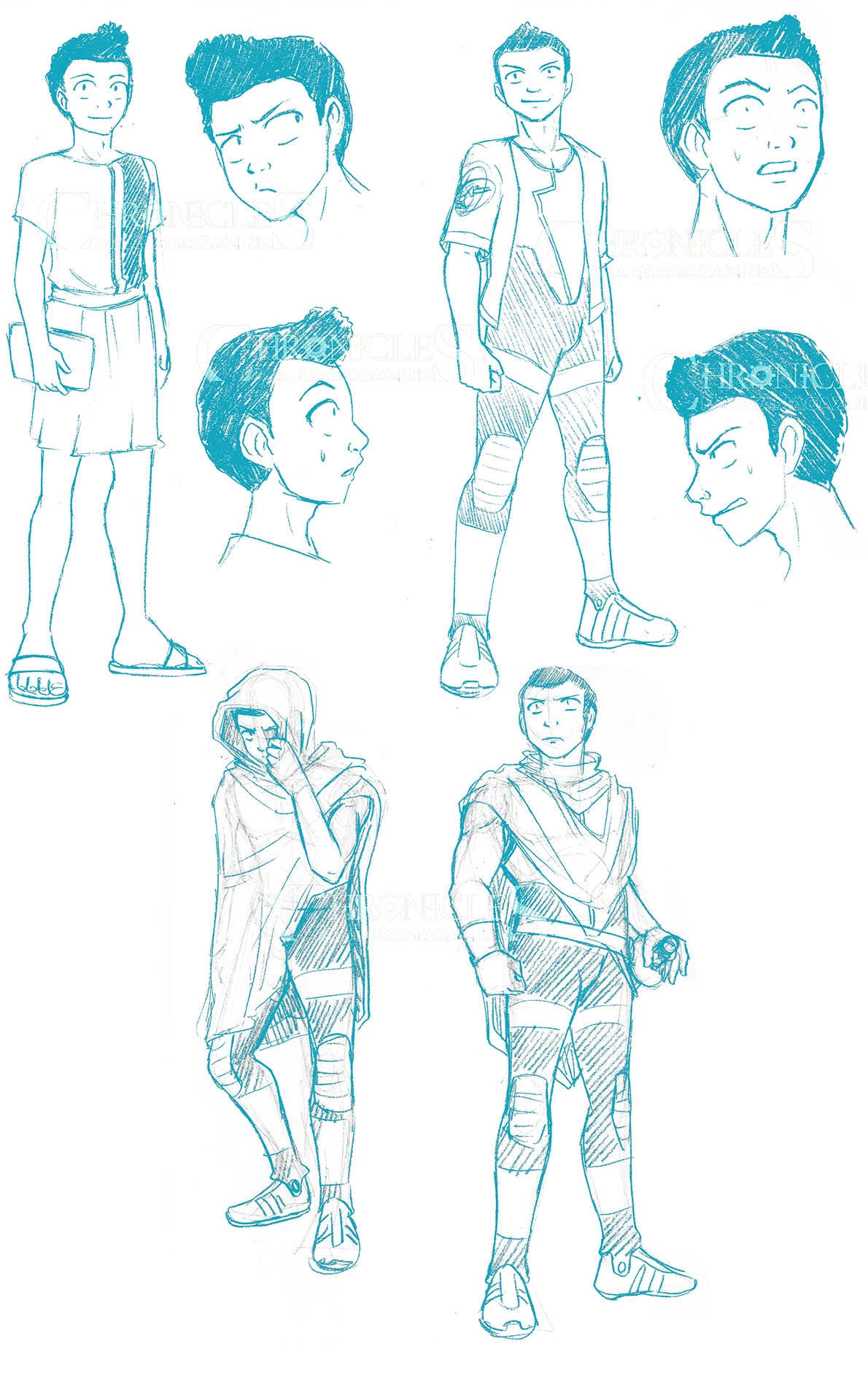
Initial sketches and studies of Damide, from Calypso V
Alice Boffa
Manga artist and musician, known for her exhilarating yon-koma manga volumes.
1. What drives you to create stories?
I have always wanted to tell stories and make people dream with my tales. I have also been drawing for as long as I can remember. Initially, I wanted to write books, but dyslexia made that very difficult. It was the world of comics and manga that enlightened me, showing me that I could tell stories through images and thus circumvent my initial problem.
2. What inspired the story published on Chronicles?
I first got the idea for ‘Calypso V‘ watching the film ‘Tank Girl‘ (based on the comic book of the same name) when I was 16. The version you are reading now bears no resemblance to that first, terrible draft; only a few scattered characters remain, having evolved into new forms. The underwater setting and fusion of advanced technologies with ancient Roman traditions are recent additions. These stem from my love of the sea and my enjoyment of the art, history and mythology of ancient Greece and Rome.
3. Describe your process for creating a character, including what you start with, what inspires you, and what challenges you.
I rarely start by designing a character. They take shape alongside the story. I try to understand what kind of character the story needs, as well as their movements, reactions and emotions. The name-note helps to define both the character and the design, as well as the story itself. Once I have defined the character through the name-note, I refine the design to make it more interesting and defined, even though their main features are already clear in my mind at this point in the process.
If I find it difficult to interpret or understand one of my characters, I try to associate them with someone I know or an existing character. This gives me a basis to start from, and I can then model them in a way that works for the story.
3. How about your process as a script writer?
Once I have an idea for a story, I try to identify the elements that seem most important to me and that I like the most. Then, I make a list of ‘macro events’ to identify the most important moments. I then develop each of these points with a list of smaller events that provide a better understanding of what happens in the story and allow me to correct anything that doesn’t add up. At this stage, the list is in chronological order.
Before drafting the name-note, I consider how to edit it to make the storytelling more interesting and effective.
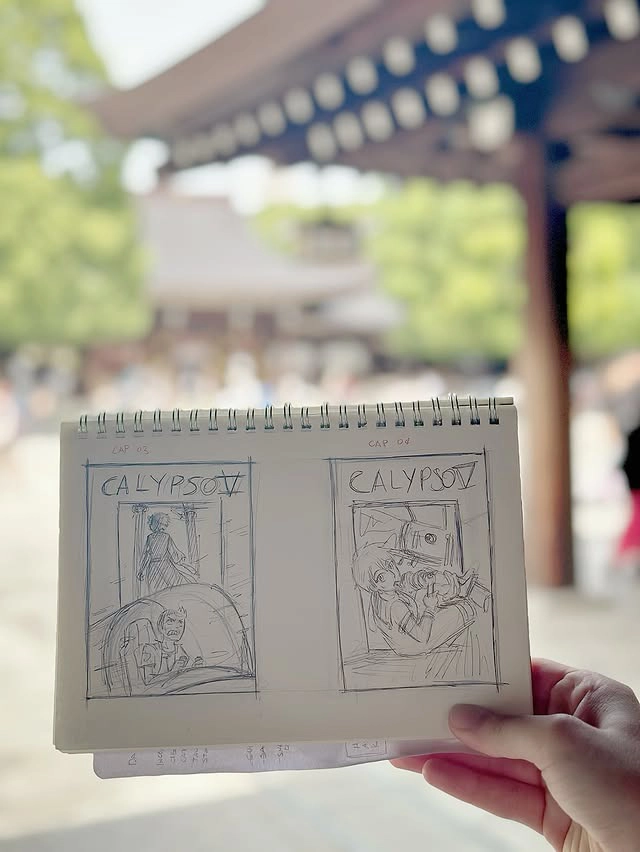
Sketches of cover illustrations of upcoming chapter for Calypso V with Alice’s beloved Meiji Jingu, Tokyo, in the background.
4. What tools do you use the most?
I work exclusively with traditional techniques, using paper and ink.
For manga, I use IC B4 paper, Pilot ink and Nikko G-pens for thicker lines. I also alternate between Tachikawa 77 Maru-pens and Nikko Maru-pens, depending on the line type and effect required. My favourite screentone is the I-C S-71, which I always use in my drawings. It is clear and easy to overlay and blend.
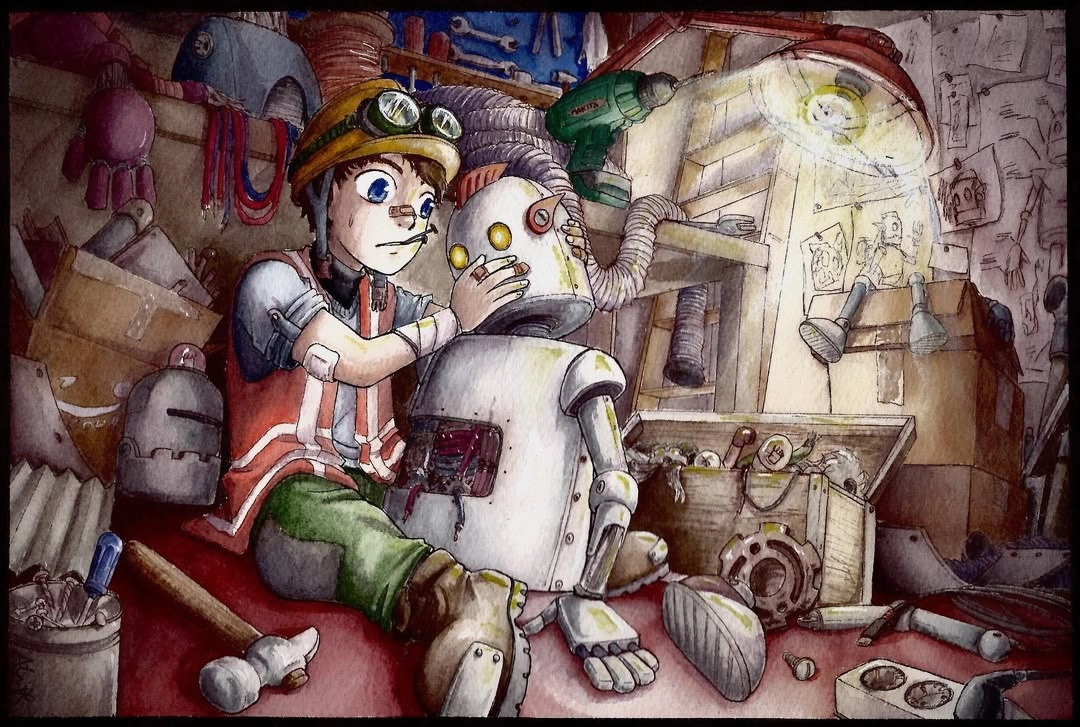
Watercolour illustration of an original character by Alice
5. What kind of scenes move you the most when you’re drawing?
I love drawing scenes where characters experience strong emotions. Regardless of the type of emotion and atmosphere, whether comic or tragic, when characters openly show what they feel, it’s as if I can feel their emotions in the ink flowing from the pen tip to the paper.
I also enjoy dynamic scenes, but they often prove more challenging than emotional ones.
6. Your main sources of inspiration right now:
Music is always a huge source of inspiration for me when I’m trying to imagine scenes and characters, and the genre I listen to changes depending on the moment: I listen to everything from indie folk to metal.
When it comes to technique, I draw inspiration from my favourite works, trying to create a style that I really like – but I still have a lot to learn before I can consider myself any good.
I recently revisited Hiromu Arakawa’s “Fullmetal Alchemist” because I would like to learn how to use a captivating narrative rhythm that is never boring. I like how simple frames without excessive detail can be impactful, effective, balanced, expressive and beautiful. Unfortunately, this conflicts with my horror vacui, and it’s something I’ll continue to struggle with.
Then, I can’t fail to mention Eiichiro Oda’s One Piece. I always carry it in my heart and continue to study its narrative rhythms.
7. Who would you choose to collaborate with if you could work with a Japanese professional artist / writer?
I would like to work with Hiro Mashima because I imagine him to be a fun person, given the stories he writes. I also really like how he has developed his inking in the latest issues of Fairy Tail. However, if I wanted to work on my technique even more, I would choose Takehiko Inoue because he is extremely talented and undoubtedly skilled.
Alice using a Pentel fude-pen to ink a sketch of Damide from Calypso V.
8. What do you want to convey with the story you’re publishing on Chronicles?
I want to convey a sense of exploration, of going “beyond”. I want to encourage people to ask questions, even when everything seems to make sense and be in stable equilibrium. In other words, I want to encourage people to leave the cave (to quote Plato).
9. How do you deal with work stress and creative blocks?
When I’m feeling particularly stressed, I go for a run or play sports to use up my energy, in the hope that I’ll be able to rest well and be more clear-headed the next day to face the challenges ahead.
If I am more deeply troubled, however, I play music or sing, or spend time outdoors in nature. If possible, I go out of town for a day to get away from it all.
Sometimes, all I need is a short walk, some breathing exercises and a hot shower before bed. The next day, I tend to feel refreshed and more proactive in overcoming the obstacles that had blocked me the previous day.
10. Describe one of your typical workdays. Do you have any rituals to help you immerse yourself in the creative process? Is there a specific place or type of music that helps you?
I try to get up early in the morning. Regardless of how tired I am, or how I feel physically or mentally, I force myself to exercise and do some stretching. After breakfast, I walk to my studio, open all my files and start my playlist to work on the story. If I am working on the plot, I isolate myself completely, trying to immerse myself in the narrative. On the other hand, once I’m in the drawing phase, I don’t need to think as much, so I can chat with my colleagues a little.
While I work, I often drink herbal or regular tea, especially in winter. When I feel unable to concentrate, I take a break: I get up, stretch and walk around for a while before going back to work.
In the evening, once I’ve finished work, I try to disconnect from everything in order to relax and be more productive the next day. To achieve this, I distract myself by playing music, cooking (which I really enjoy) and watching TV series or movies. Every now and then, my routine is interrupted by teaching at the European Manga Academy, but otherwise my days are very similar.
I often work on Saturdays, but I always try to keep Sundays free for rest or trips out of town.
Alice’s Instagram
While working as a teacher assistant at the European Manga Academy after her own graduation and a year abroad in Japan, Alice began working on a comic project as a way to let off steam and entertain her fellow assistant. Unfortunately for her, it was so good she was encouraged to keep going and get it published! Three volumes later she vowed never to draw yon-koma manga again… and yet she did.
• RumXXX (volume 01, 02, 03, or complete set)
• The world of Liz Supermais (one-shot complete volume)
Despite her undiscussed talent as a yon-koma manga artist, there’s more to Alice’s skills than that.
Her first publication was a children’s book and she’s taken part in other projects as well:
• Miró’s Journey (ita / fr)
• Sirenya (volume 1 / volume 2)
She has also been sharing illustrations of her original characters on her Instagram page. Look out for the astronaut! 👨🚀